The online Executive Master of Business Administration (EMBA) program is an eighteen-month
program uniquely designed to meet the needs of experienced professionals seeking an
MBA degree with minimal disruption to their professional and personal responsibilities.
The program combines advanced business knowledge with practical leadership development
to prepare professionals for executive and managerial roles across private, public,
nonprofit, and energy-sector organizations.
The program is delivered entirely online through Canvas, a leading learning management
system that supports virtual classrooms, live discussions, online lectures, assignments,
and collaborative learning. The flexible course schedule allows students to maintain
full-time employment while pursuing their graduate degree. Designed specifically for
working professionals, the EMBA program does not require the GMAT or GRE for admission.
Instead, the program emphasizes professional work experience, leadership potential,
and academic achievement as key admissions criteria.
Testimonials
Veronica L. Weathers, eMBA Graduate, Fall 2018
Christine McMonagle, eMBA Graduate, Fall 2018
Curriculum
The program consists of 30 credit hours. Students are required to complete ten courses
and progress through the program in a cohort model, where a group of students advances
together through five semesters and ten courses.
The Executive MBA program offers a General Business Administration curriculum designed to provide broad managerial, strategic, and leadership competencies
applicable across industries and organizations.
Careers
Graduates gain the knowledge and leadership capabilities necessary to become effective
executives, managers, entrepreneurs, and business leaders across a wide range of industries.
Career opportunities include:
Finance
Organizational Leadership
Human Resources
Investments
Treasury Management
Risk Analysis
Business Operations
Oil and Gas Business Systems
Business Intelligence and Strategy
Management Information Systems
Marketing
Government and Nonprofit Management
Supply Chain Management
Management Consulting
Business Analytics
Strategic Planning
Project Management
Executive Leadership
Representative leadership positions include:
Chief Executive Officer (CEO)
Chief Operating Officer (COO)
Chief Financial Officer (CFO)
Vice President
Director of Operations
Program Director
Senior Project Manager
Supply Chain Director
Corporate Strategy Manager
Business Development Executive
Employment Outlook
The Executive MBA (EMBA) is designed for experienced professionals seeking advancement
into senior management and executive leadership positions. EMBA graduates commonly
pursue leadership roles in operations, finance, consulting, business development,
entrepreneurship, project management, and organizational leadership.
Compensation varies based on industry, geographic location, years of experience, and
level of responsibility. The EMBA can serve as a pathway to executive and management
positions that often offer greater earning potential, increased organizational influence,
and expanded career opportunities.
The Master of Business Administration (MBA) remains one of the most respected graduate
business degrees, preparing professionals for leadership roles across industries including
healthcare, energy, finance, technology, government, consulting, and entrepreneurship.
Application Process
Applications to the Online Executive MBA Program are reviewed on an ongoing basis.
To be considered for admission, applicants must submit all required application materials.
Applications are evaluated holistically based on academic performance, professional
accomplishments, leadership experience, and recommendations.
An ideal candidate possesses a bachelor's degree and a minimum of five years of progressive
professional experience, preferably with managerial or supervisory responsibilities.
$50 Non-Refundable Application Fee - payable to Texas Southern University
Official Transcripts Please send two (2) official transcripts from each college, university and graduate
school attended as a registered student. Each transcript must be enclosed in the Registrar’s
sealed envelope and either returned to you for inclusion in your package or sent directly
to the Online Executive MBA program office.
Professional Resume Please include a current resume detailing your professional work experience and areas
of responsibility. The resume should reflect work experience beyond earning your baccalaureate
(undergraduate) degree.
Statement of Purpose Please write a concise essay of no more than 500 words (2-page), explaining your reasoning
for seeking an advanced degree in business, describing how the program will help facilitate
your career goals. Discuss your professional and executive experience in detail that
relates to the pursuance of this program. Discuss what you anticipate will be your
most significant contribution to the Online EMBA Program and to other program participants.
Please also reflect on your greatest accomplishment and disappointment, and lessons
learned from the experience.
Two (2) Letters of Recommendation Two letters of recommendation are required, including one from your immediate supervisor.
Letters of recommendation should be obtained from individuals who know you well and
can present a balanced evaluation and assessment of your capabilities. Letters should
include your strengths, areas for improvement and commitment to academic excellence
in a rigorous program.
Tuition
The current published tuition rate is:
$6,000 per term
$30,000 total program cost (five terms)
Program costs include tuition, books, case studies, and required course materials.
The Global Immersion Experience (GIE) is a distinctive component of the Executive
MBA program at the Jesse H. Jones School of Business. Designed to broaden students'
understanding of international business, the GIE provides opportunities to engage
with global organizations, business leaders, and diverse cultural environments through
experiential learning.
From 2009 through 2019, the program organized international business immersion experiences
in China and Japan, providing students with valuable exposure to global markets, international
business practices, executive leadership perspectives, and cross-cultural management.
These experiences included corporate visits, professional networking opportunities,
executive presentations, industry briefings, and cultural activities that enhanced
students' understanding of the global business environment.
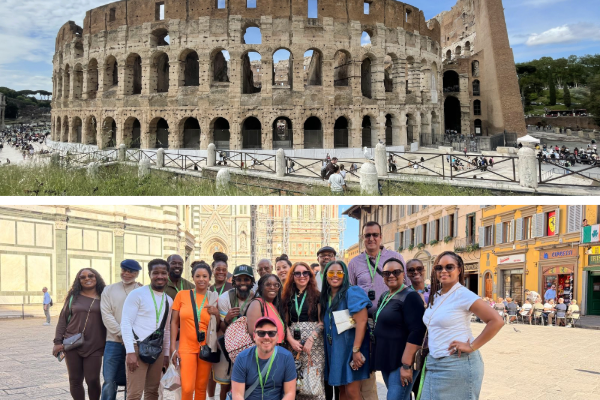
Following a temporary suspension during the COVID-19 pandemic, the Global Immersion
Experience resumed in 2025 with an international business study tour of Italy. Building
on the success of that experience, the program returned to Italy in 2026, further
strengthening its commitment to global business education and international engagement.
During the Italy experiences, EMBA students visited businesses and organizations in
Milan, Florence, and Rome, gaining firsthand insights into international business
operations, innovation, entrepreneurship, leadership, sustainability, and global economic
trends. Through corporate visits, executive briefings, networking opportunities, and
cultural engagement, students developed a deeper understanding of the opportunities
and challenges facing organizations in an increasingly interconnected global marketplace.
The Jesse H. Jones School of Business is also exploring opportunities to expand international
engagement through strategic partnerships with leading institutions abroad. Current
discussions include collaboration with the University of Perugia (UNIPG) in Perugia,
Italy, to advance academic exchange, executive education initiatives, faculty and
student engagement, research collaboration, and global business learning opportunities.
The Global Immersion Experience reflects the program's commitment to developing globally
minded leaders who can effectively navigate complex business challenges across international
markets and cultures.
Participation and Funding
Global Immersion Experiences are offered based on available funding, university approvals,
international conditions, and sufficient student participation. International travel
opportunities are reviewed periodically and require approval from the appropriate
Texas Southern University administrative offices.
Students participating in the Global Immersion Experience are generally expected to
contribute a significant portion of the travel-related expenses, which may include
airfare, lodging, meals, local transportation, passport and visa fees (if applicable),
and other personal expenses. The Jesse H. Jones School of Business continually seeks
opportunities to enhance the affordability and accessibility of these experiences
through partnerships, sponsorships, and program support when available.
Because international business experiences require substantial planning, financial
resources, and institutional coordination, specific destinations, travel schedules,
and program offerings may vary from year to year. Participation in a Global Immersion
Experience is dependent upon available funding, administrative approval, international
conditions, and adequate student interest and enrollment.
Recent Global Immersion Destinations
Italy (2026): Milan, Florence, Perugia, and Rome
Italy (2025): Milan, Florence, and Perugia
Japan
China
Through international business engagement and experiential learning, EMBA students
gain valuable global perspectives that complement classroom instruction and strengthen
their ability to lead effectively in today's dynamic and interconnected business environment.
eMBA China trip - December 2018
Introduction: A group of eMBA students went on an experiential learning tour to China from December
2-12, 2018. This report summarizes the key elements of the tour that explains how
the integration of the overseas trip into the eMBA curriculum supports the engagement,
innovation and its impact on the overall students’ learning.
Business Visit 1- ChinaSense: This is a service-oriented business whose mission is
to plan and host study trips for foreign executives and business education institutions.
The presentation focused on what, why, and how of the changes that took place in the
Chinese dynasty and its influence on the business paradigm of China over the years.
Business Visit 2- Pactera: Pactera is a global company offering consulting, digital, technology and operations
services to the world’s leading enterprises. The basic presentation was the general
evolution of the company and its evolving gradual global presence.
Business Visit 3- witmart.com: This is a service firm that provides companies to find freelancers. The key takeaway
of this visit was how a Chinese company uses information technology in the form of
eBusiness to reach out to businesses globally.
Business Visit 4 – Han Kun Law Firm: The presentations by the legal team of two professional of this firm gave a very detailed
understanding about complexity involved in dealings by the global companies in complex
cross-border and domestic transactions.
After the visit to businesses in Beijing, the next three visits included three companies
in Shanghai -- Baowu Steel, US Commerce office, and 3M China Research center. Students
traveled from Beijing to Shanghai via the Bullet Train.
Business Visit 5- Baowu Steel, China: The visit five to Baowu Steel was a unique experience that gave students an opportunity
to witness a live operation of how the steel is rolled out in a typical steel plant.
A key takeaway from this visit was the understanding of a large industry that is state-controlled
and trying to compete in the global market and at the same time keeping up with the
clean environment.
Business Visit 6- U.S. Commerce Office: The sixth visit was a meeting with the US Commerce Office personnel. The presentation
mainly focused on how their office helps the U.S. businesses to partner with the businesses
outside U.S.A. in the global market. Business Visit 7- 3M China Research Center: The visit started with the presentations of 3M products displayed in their showcase
by one of the 3M company employees. The key takeaway of the presentation was the awareness
of wide variety of products 3M offers.
Cultural Site Visits: In addition to the visit to the businesses, visits to various cultural sites were
planned. The key highlights of the visit included the tours of The Great Wall of China,
Tianamen Square and the Forbidden City, visit to local markets and mall both in Beijing
and Shanghai, Yu Garden and Bazar, Zhujiajiao Water Town, Jade Buddha Temple, Shanghai
Tower, and Huangpu River cruise. The key takeaways of visits to cultural sites was
learning about the detailed history of the Chinese culture, people, the evolution
of dynasty and its influence on Chinese people in general, and so on.
Summary: Overseas visits provide students a unique opportunity and experience that cannot be
simulated in a traditional online or face-to-face class setting. It is a strategy
that emphasizes “engaging” students in learning process in an “innovative” way that
leads to an effective impact on students’ “learning”.
The Global Immersion Experience is an essential component of the Jesse H. Jones School
of Business/Online Executive MBA (EMBA) experience. Each year, the School organizes
two international business trips to destinations in the spring and fall semesters
for two separate EMBA cohorts. During the last nine years, students traveled to the
People Republic of China. The trip usually includes corporate and cultural tours and
meetings, sightseeing, visits with expert panels, and free time for the students.
The students are afforded exposure to international business and cultural awareness,
and more importantly, the opportunity to learn about international trade and commerce.
The international business trip is usually offered through a third-party vendor specializing
in providing international business trips for executive MBA students. During May 2019,
a group of sixteen (16) online executive MBA students and faculty traveled to Japan
for the Global Immersion Experience trip. The students met with representatives from
companies such as Nissan Motors Corporation, Toyota, and Plastic Chemical recycling
plant. Highlights of the trip included a visit to the Yokohama National University
(YNU) campus to the Faculty of Economics where Dr. Alexander McAulay delivered a lecture
on the history of Yokohama as Japan’s gateway to the west and other YNU academic programs.
During the second session, the group also learned about Japanese Law and Business
from professors Ichiro Araki and Mashaisa Suzuki.
"The Global Immersion Experience was very important,” explained student Porcherria
Johnson. “I think it is beautiful to experience cultures other than our own. Going
to Japan was an amazing experience to learn about the culture, Japanese work ethics,
and their unwavering commitment and dedication to work culture and traditions.”
During the trip, students visited many places in Yokohama, Nagoya, and Tokyo and met
with the United States commercial Attaché Mr. Dave Averne, who served in China for
ten years before coming to Japan a few years ago. He discussed the volume of trade
between the United States and Japan, potential opportunities in IT, and nuclear power
plants protections against earthquakes and seismic activities. He provided insight
on differences between Chinese and Japanese cultures, work habits, and opportunities.
Ms. Taylor Thierry, an EMBA student, mentioned, “Being on the ground in a foreign
country studying their economy and direct observation really brings to life what we
learned in the classroom and in our readings. For me, it was a terrific opportunity
for bonding with my fellow cohorts and sharing travel experiences." The students learned
that traveling by trains was the most convenient and fastest method of transportation
within Japan. Dr. Johnnie Williams joined the group of students on a high-speed train
from Nagoya to Tokyo while Mr. Haider traveled with eight students on the bus. All
Japanese cities offer a local subway system, and these subways are connected with
Japan Rail or JR stations.
The group visited the Nissan Car Manufacturing Plant and witnessed the engine manufacturing
process while walking through the assembly line. The group also visited the Toyota
Motomachi plant in Toyota City and learned about the Toyota manufacturing process
as they visited the plant assembly line. Upon entrance, the group was greeted by a
giant sign in the assembly area “Good Thinking, Good Products.” The students later
learned about “lean” manufacturing or Toyota Production System (TPS), which has helped
the Toyota Corporation, become the largest car manufacturer in the world. The host
later told the group the students that good products come from good thinking. The
group also learned about five main principles of legendary Kiichiro Toyoda, the founder
of Toyota Motor Co., Ltd.
 Application Process

 Business Visit 2- Pactera: Pactera is a global company offering consulting, digital, technology and operations
services to the world’s leading enterprises. The basic presentation was the general
evolution of the company and its evolving gradual global presence.
 In addition to the visit to the businesses, visits to various cultural sites were
planned. The key highlights of the visit included the tours of The Great Wall of China,
Tianamen Square and the Forbidden City, visit to local markets and mall both in Beijing
and Shanghai, Yu Garden and Bazar, Zhujiajiao Water Town, Jade Buddha Temple, Shanghai
Tower, and Huangpu River cruise. The key takeaways of visits to cultural sites was
learning about the detailed history of the Chinese culture, people, the evolution
of dynasty and its influence on Chinese people in general, and so on.